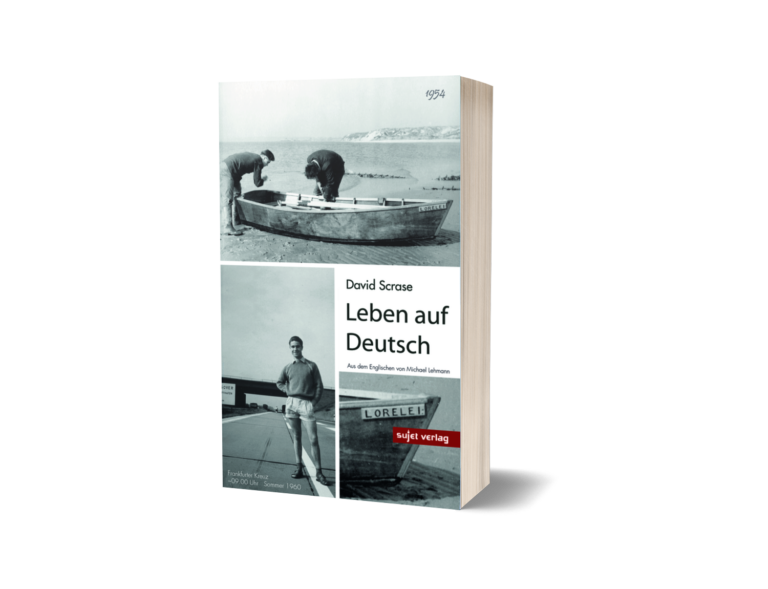
Review autobiography David Scrase
by Wolfgang Menzel
Just two days after Wilhelm Lehmann died in Eckernförde on November 17, 1968, an obituary appeared in the London daily newspaper “The Times”. The author of the obituary, David Scrase, describes how this international recognition came about in his autobiography “Life in German”: A young English German scholar, in his late twenties, a temporary lecturer in German at Oxford and also working on his dissertation on Wilhelm Lehmann, receives a telephone call from friends in Bremen saying they had heard on the radio that Lehmann had died. Encouraged by other friends, David Scrase offers an obituary to The Times. And actually, people are interested. David sits down and writes; then dictates the text into the telephone (there was no Internet or fax yet). And the next morning half of England knows who Wilhelm Lehmann was. A journalistic coup – told more than half a century later with typically British understatement.
Not just this anecdote, the whole book is worth reading. Loosely told like a novel, with self-distance, humor, self-confident modesty and the occasional wink, sensitively translated from English by Michael Lehmann, it is an entertaining and unobtrusively educational read. An academic career that was not atypical for the time, but nevertheless special, and a, yes, happy life with the German language, literature, culture and history - and for her. David Scrase, born on November 27, 1939, during the Second World War and raised as a British working-class child in a village in Dorset, southern England, discovered his love for German literature and culture early on. After various positions in other countries, he became a German studies professor in Vermont (USA) and founding director of the Center for Holocaust Research there. He has written the only Wilhelm Lehmann biography to date (Wallstein-Verlag 2011) and edited volume 5 “Stories” of Lehmann's collected works (Klett-Cotta 1994).
David Scrase: "Life in German. About the development and work of the English Germanist and Holocaust researcher. Autobiographical novel". Translated from English by Michael Lehmann, Sujet-Verlag Bremen 2025.